
Your cart is empty
17:11 Joan of Arc: Breaking the English Line | |
 ← View more custom works
Attica Miniatures · Historical Diorama Joan of Arc: Breaking the English LineThe Maid of Orléans and the English Archers 1:32 scale 54 mm White metal Museum Quality
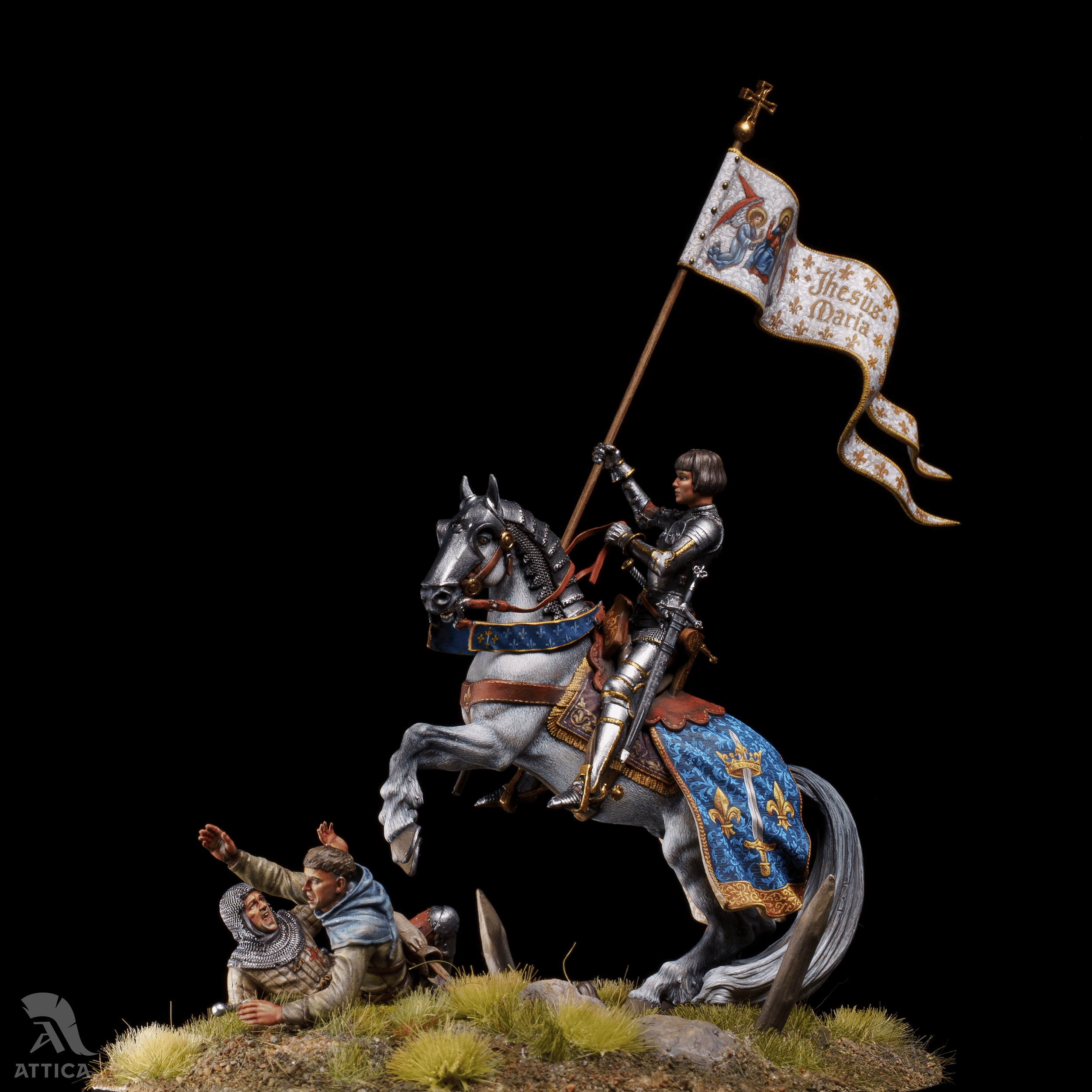
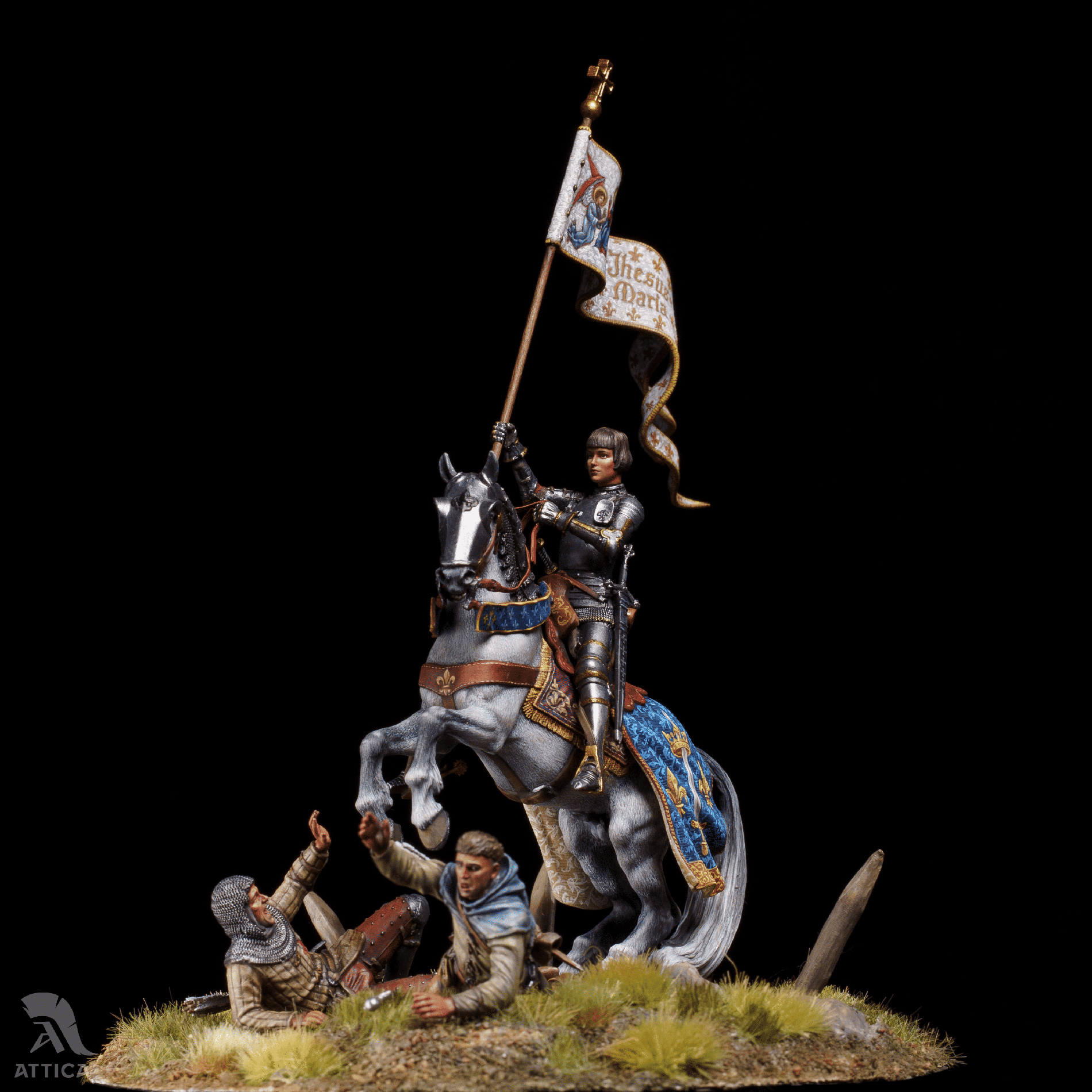
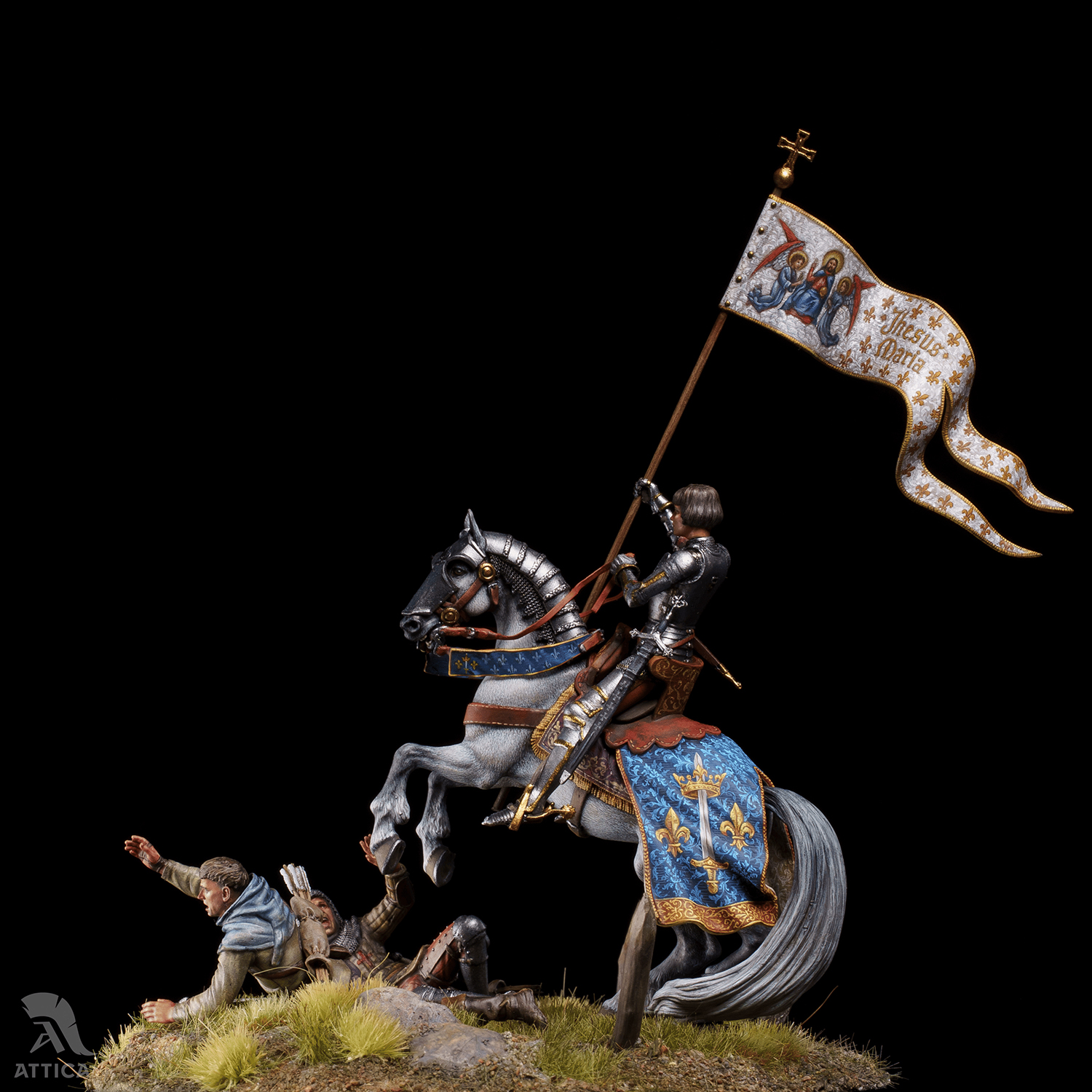
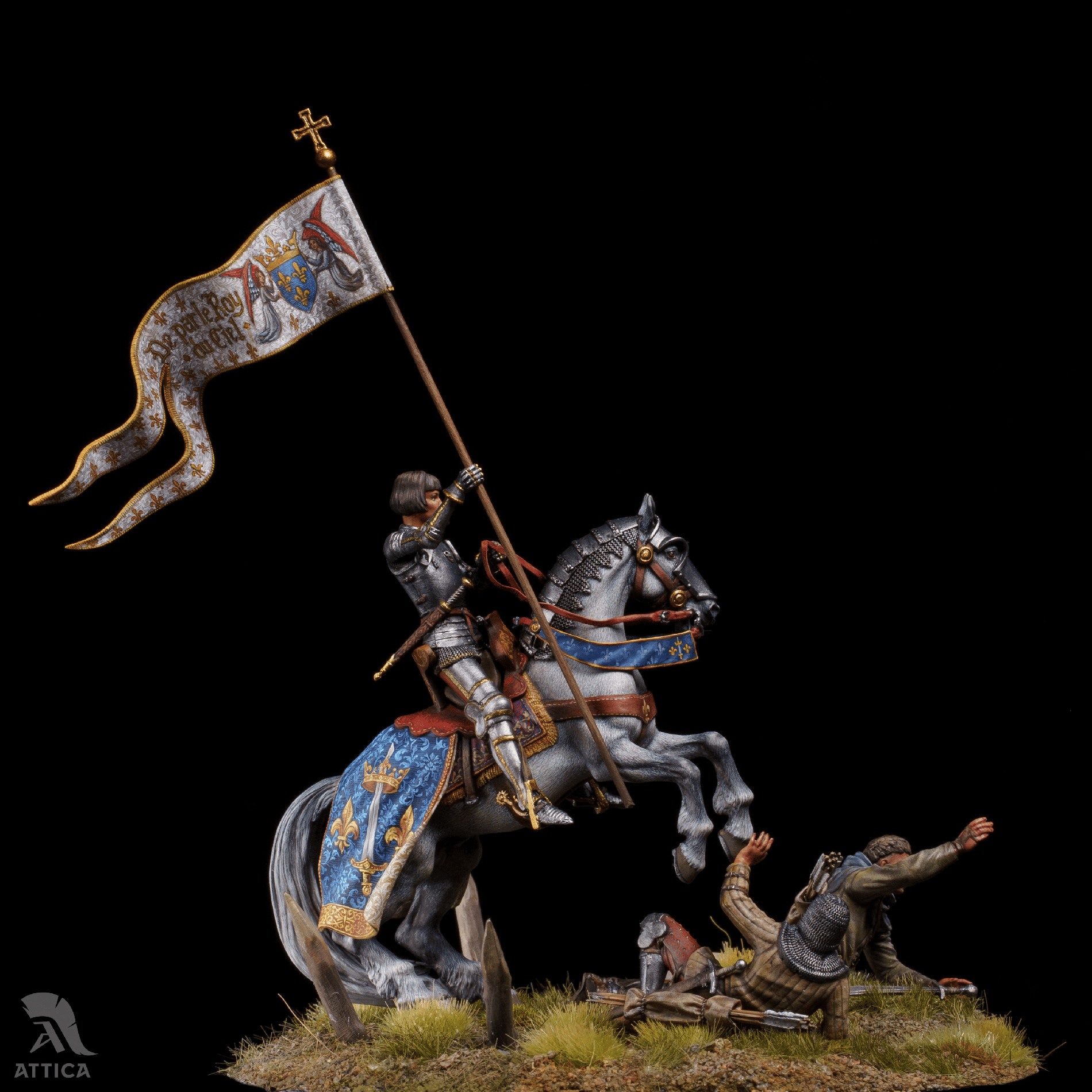
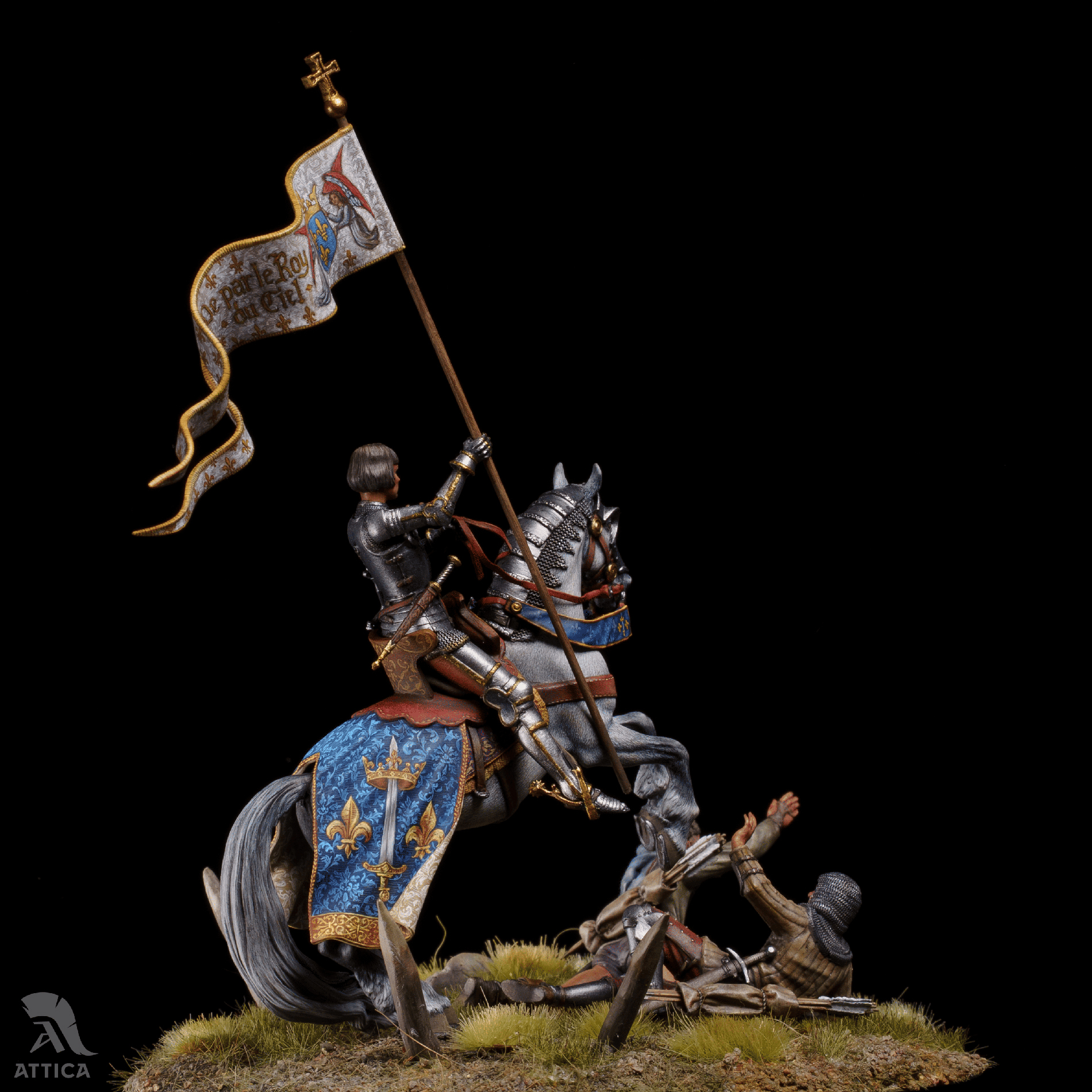
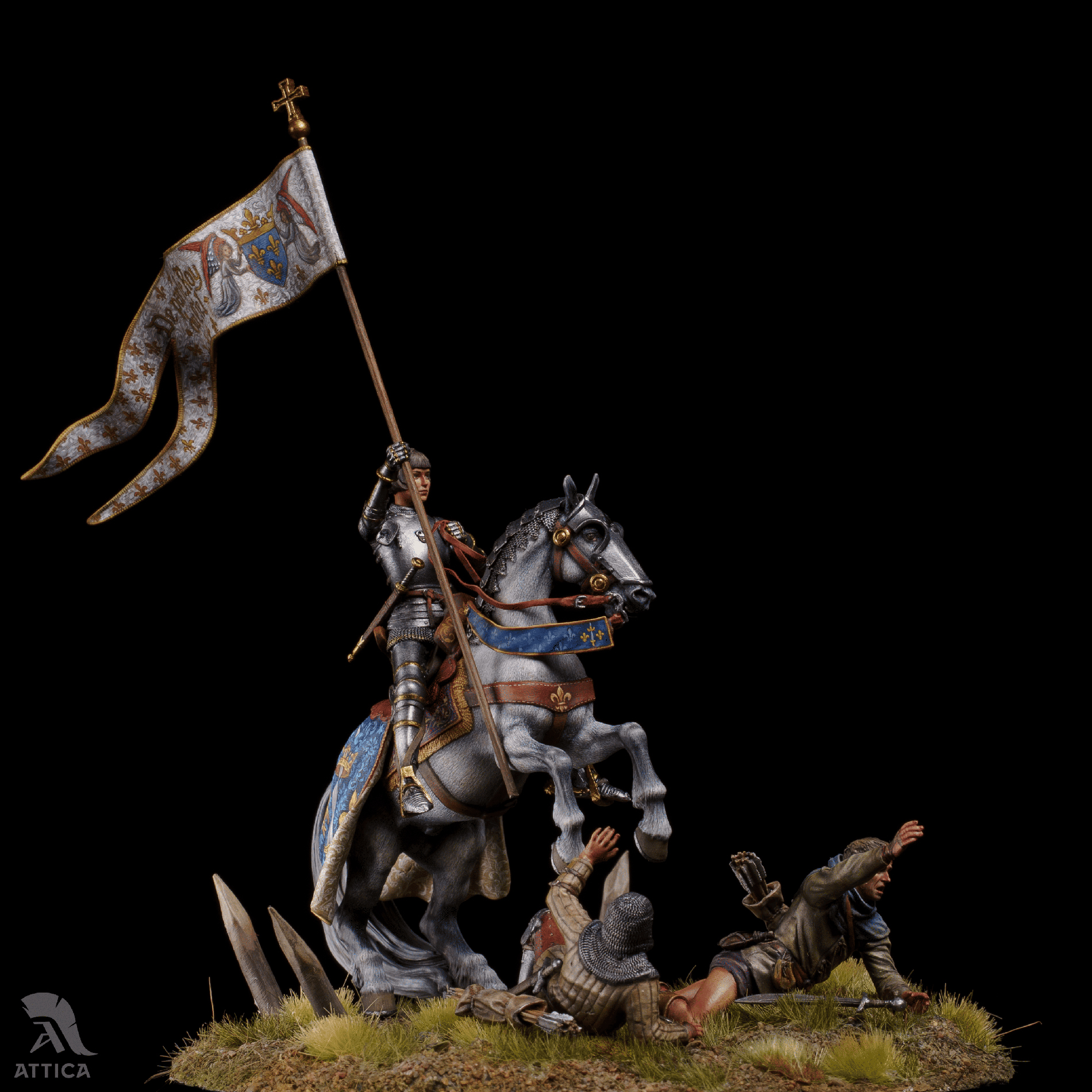
A mounted Joan of Arc bursts through the broken line of English archers. Her horse rears above the fallen men, among sharpened stakes driven into the churned ground. Yet Joan raises no sword. Believing that God watches over her, she rides into battle carrying her standard in her right hand — the emblem of the mission she believes was entrusted to her by Heaven. Project details A commission that became part of our collectionSubjectJoan of Arc (Jeanne d’Arc)
Scale1:32, 54 mm
MaterialWhite metal
Painting levelMuseum Quality
SculptureIlya Ryabov
AvailabilityAvailable to order
ManufacturerAttica Miniatures
Product codeMU754
Originally developed as a custom commission, this figure is now part of the Attica Miniatures collection and is available to order. The Maid of Orléans From Orléans to the StakeJoan was only seventeen when she arrived at the court of Charles VII, declaring that God had sent her to help free France from English control and lead Charles to his coronation. After weeks of hesitation, Charles made the extraordinary decision to place her at the head of the force sent to relieve Orléans. The news that an army was marching behind a messenger of God created a powerful surge of hope. Commanders and soldiers, exhausted by years of defeat, recovered their courage. The siege had seemed impossible to break. Yet after only four days of fighting, the English strongholds around Orléans had fallen and the siege was lifted. Even after being wounded by an arrow, Joan returned to the assault. The victory made her famous throughout France and gave her the name by which history remembers her: the Maid of Orléans — la Pucelle d’Orléans. French victories followed at Jargeau, Meung-sur-Loire, Beaugency and Patay, opening the road to Reims. Within months, Charles was crowned there, with Joan standing near him beneath her banner. Less than two years later, she was captured by Burgundian troops and sold to the English. Charles, whose coronation she had helped make possible, did not secure her release. Joan was prosecuted for heresy by a Church court supported by the English and burned at Rouen at the age of nineteen. Twenty-five years later, the judgment was annulled and the original trial declared invalid. The young woman condemned as a heretic had already become a symbol of courage, sacrifice and faith. 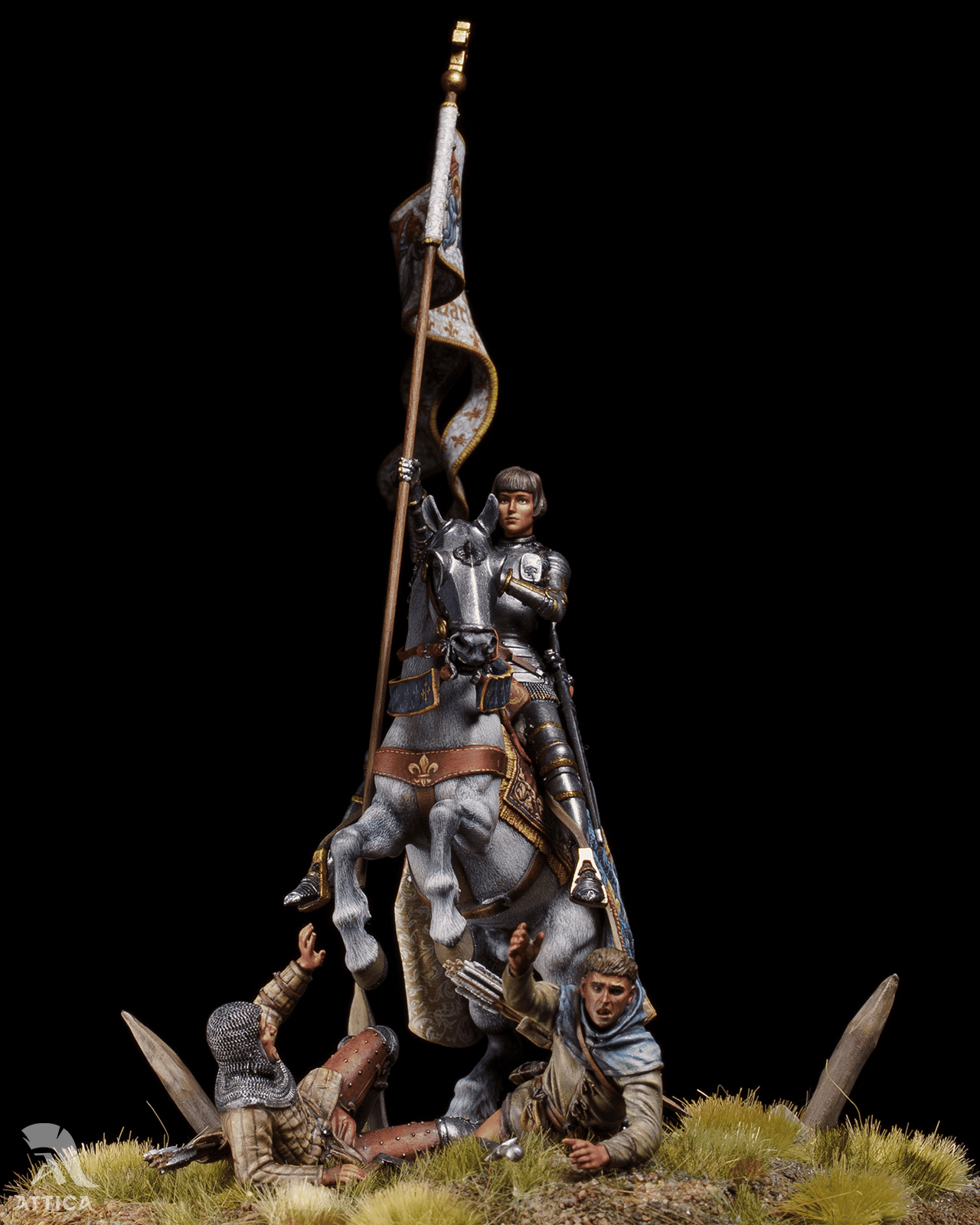 Under the Standard of Faith The Banner, Not the SwordAt her trial, Joan said that she loved her banner “forty times more” than her sword. She explained that she carried it herself when riding against the enemy so that she would not have to kill anyone. In the diorama, the standard rises above the battle as the visible expression of her faith. No original standard has survived, and the descriptions recorded by contemporaries do not agree in every detail. Its white field, gold fleurs-de-lis, sacred figures and inscriptions were painted as an artistic reconstruction informed by historical descriptions. One side bears the names Jhesus and Maria beside a sacred image of Christ in glory, holding the world and raising His hand in blessing. The reverse brings together angels, the arms of France and the words De par le Roy du Ciel — “By command of the King of Heaven.” The standard also foreshadows Joan’s fate. The same voices and religious conviction that gave a teenage girl the courage to stand before kings and armies would later be examined and used against her at trial. Raised above the fallen archers, the white banner is both a sign of victory and a foreshadowing of her martyrdom. 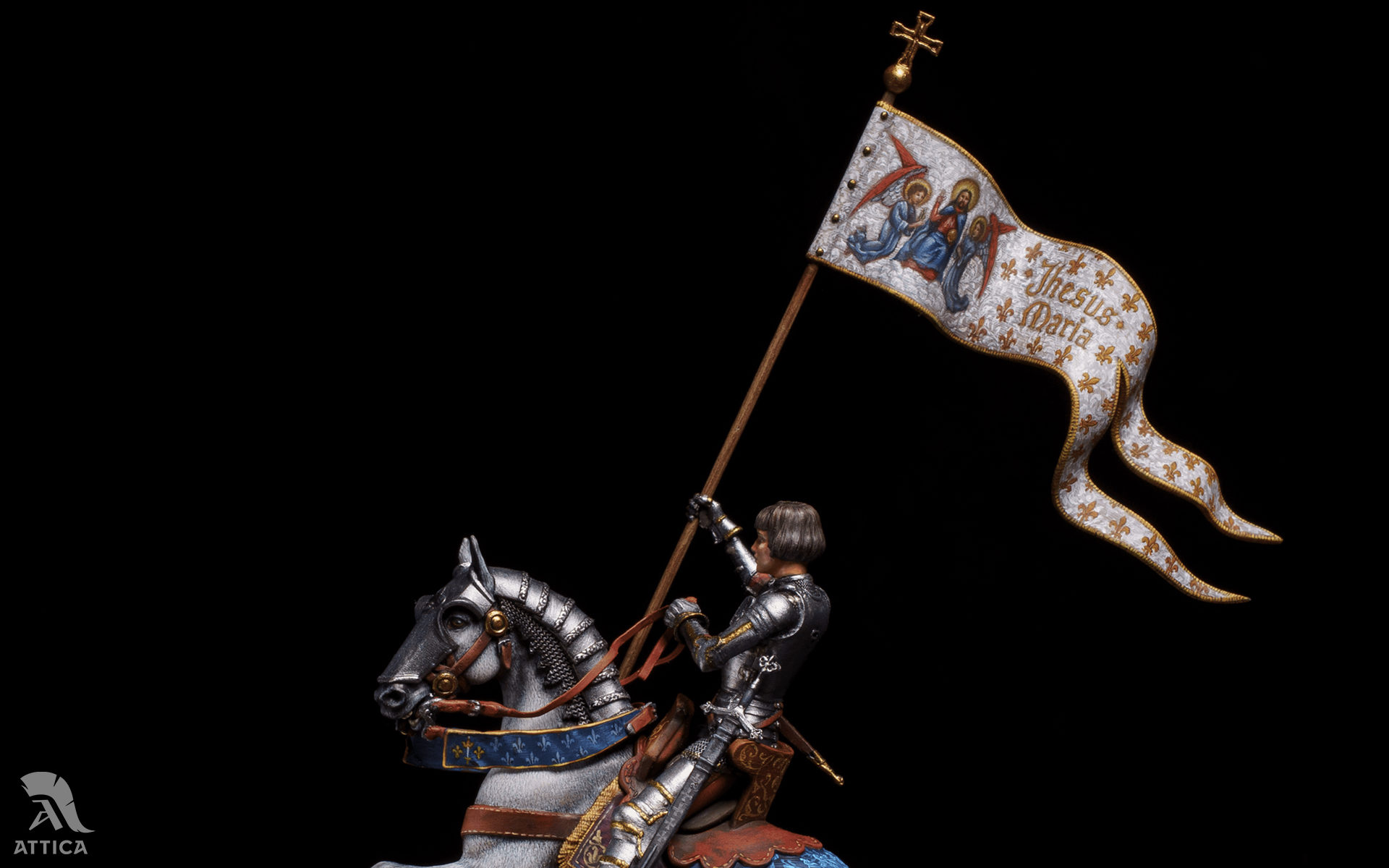 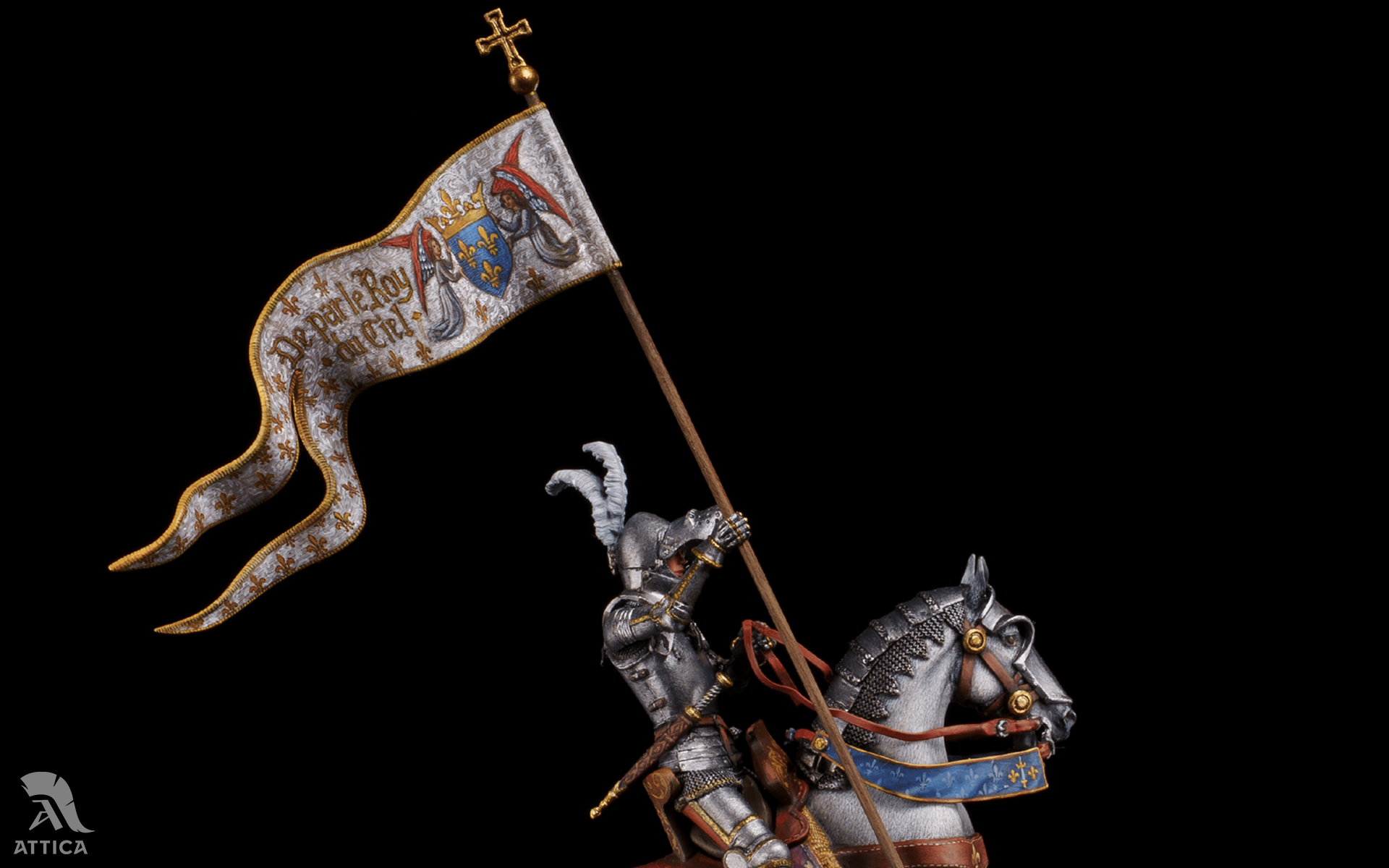 Joan’s coat of arms Heraldry in Blue and GoldJoan’s arms — a silver sword supporting a golden crown, flanked by two golden fleurs-de-lis on a blue field — appear on the horse’s broad fabric reins and caparison. These surfaces were painted not as flat fields of blue, but as richly woven jacquard. Subtle floral patterns remain visible beneath the heraldic motifs, framed by ornamental gold borders. 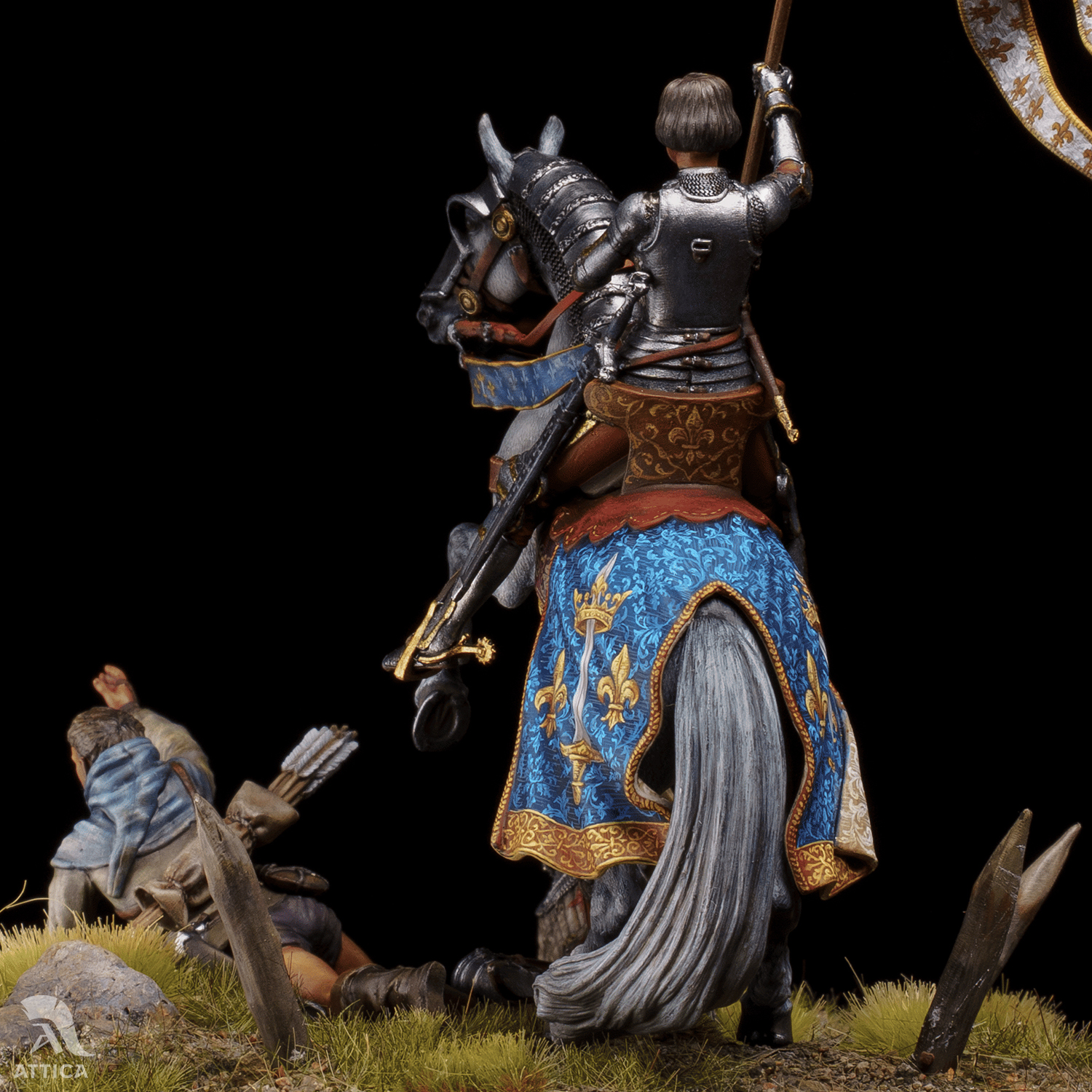 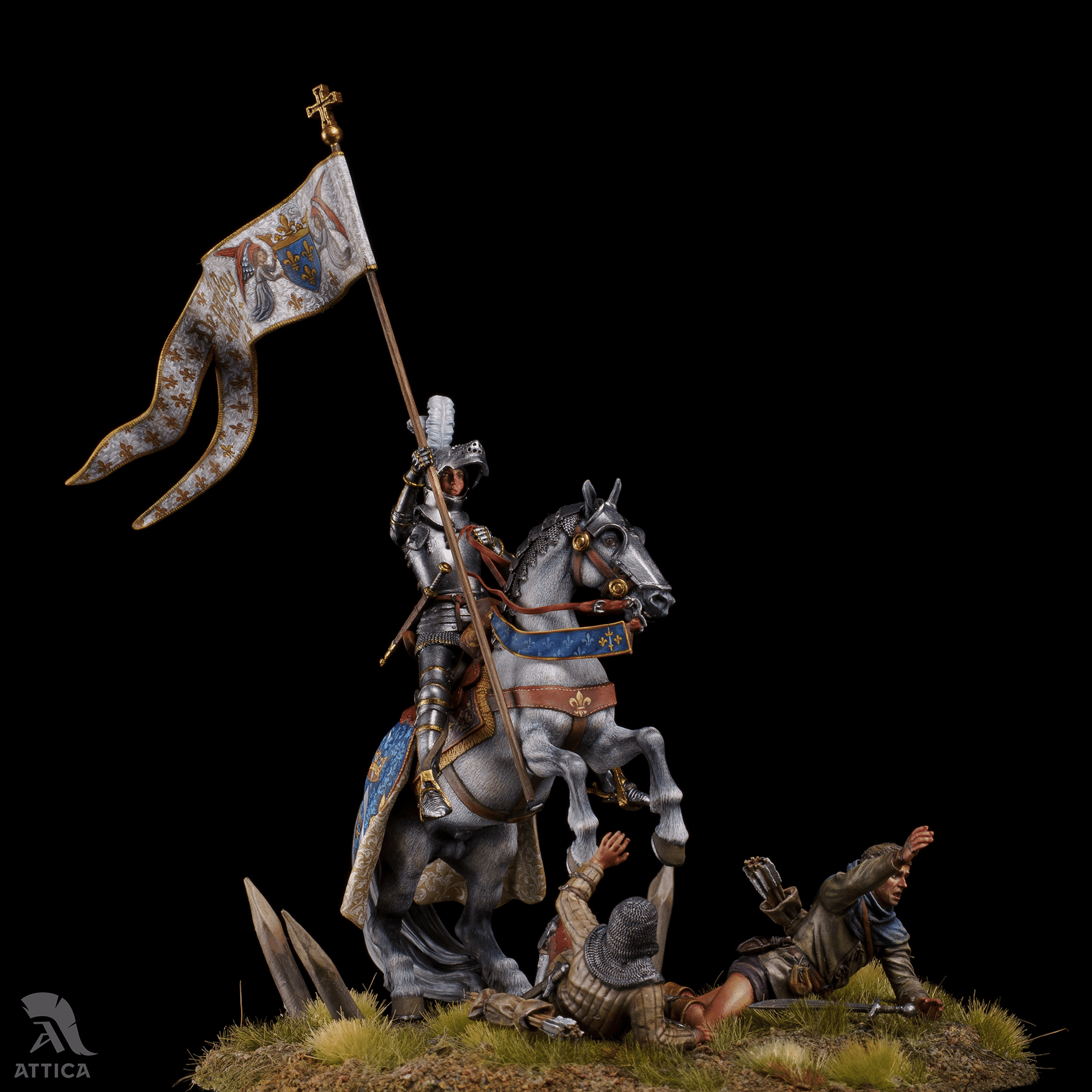 The Loire campaign Inspired by the Battle of PatayThe scene draws upon the Battle of Patay, fought on 18 June 1429 during Joan of Arc’s Loire campaign. English longbowmen traditionally protected their positions with sharpened stakes driven into the ground. At Patay, however, the French blindsided them before the defensive line had been fully prepared. Heavy cavalry broke into their position, and the lightly protected archers were overwhelmed at close quarters. The diorama does not claim to reproduce a single documented episode. The decisive cavalry charge at Patay was led by the captains La Hire and Jean Poton de Xaintrailles, while Joan followed with the rest of the French army. Here, the historical circumstances become the foundation for an artistic image of Joan at the height of her military triumph. Two English archers A Moment SuspendedBeneath the horse are two soldiers responding differently to the same approaching danger. The older archer is a hardened veteran. Knocked onto his back, he has managed to raise himself on one elbow. His face is worn, and his mouth open in terror. Seeing the hoof above him, he throws up an empty hand in a last instinctive attempt to protect his face. The second archer is much younger. Perhaps this is not his first battle, but it is the first time he has seen cavalry break through the line. His almost boyish face remains open and unguarded: eyes wide with shock, he tries to crawl clear while reaching instinctively for his sword. Their bows, canvas quivers and loose arrows have been scattered among the stakes. 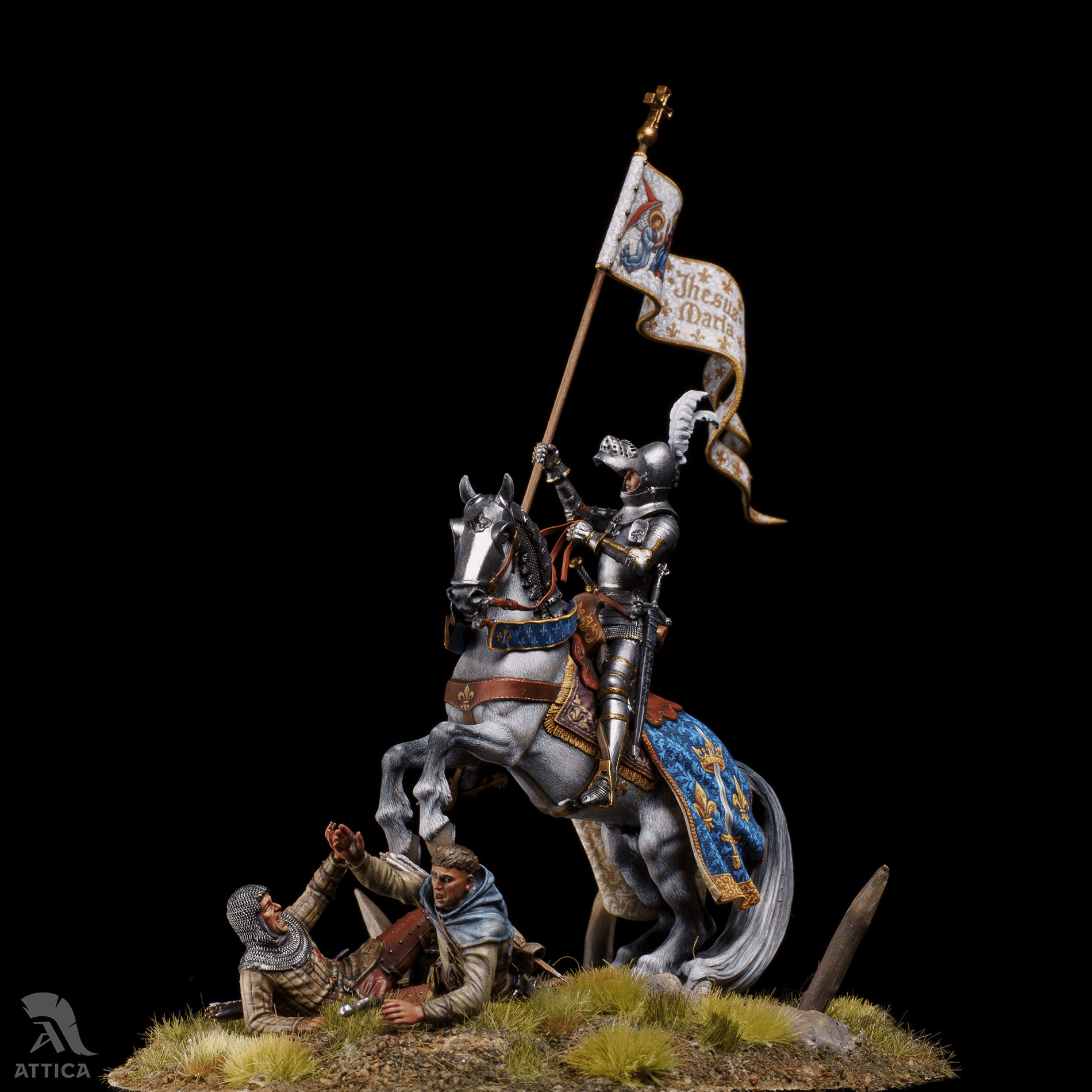 1 / 6
     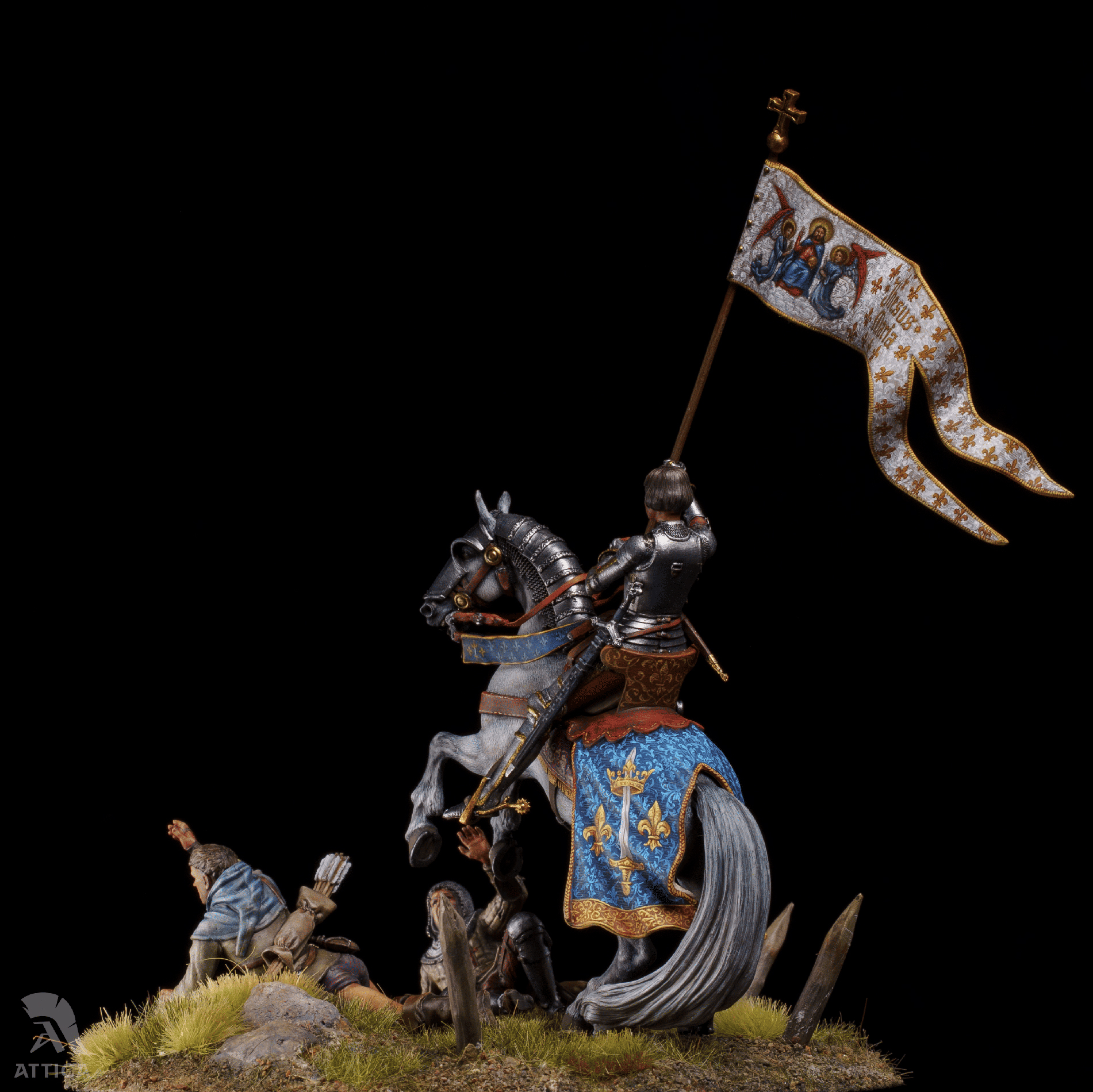 1 / 6
Interchangeable heads Two Portraits of JoanThe set includes two interchangeable heads. Displayed bareheaded, Joan’s short dark hair and youthful face become the emotional centre of the composition. This version emphasises the extraordinary fact that the figure commanding the scene is still a teenage girl. The alternative head shows her wearing a visored bascinet crowned with white feathers. It conceals much of her expression but gives the mounted figure a more martial silhouette, transforming the Maid of Orléans into an armoured commander. Together, the two versions allow the same composition to be read in different ways: as the story of a young woman sustained by faith, or as the image of a warrior already becoming a legend. 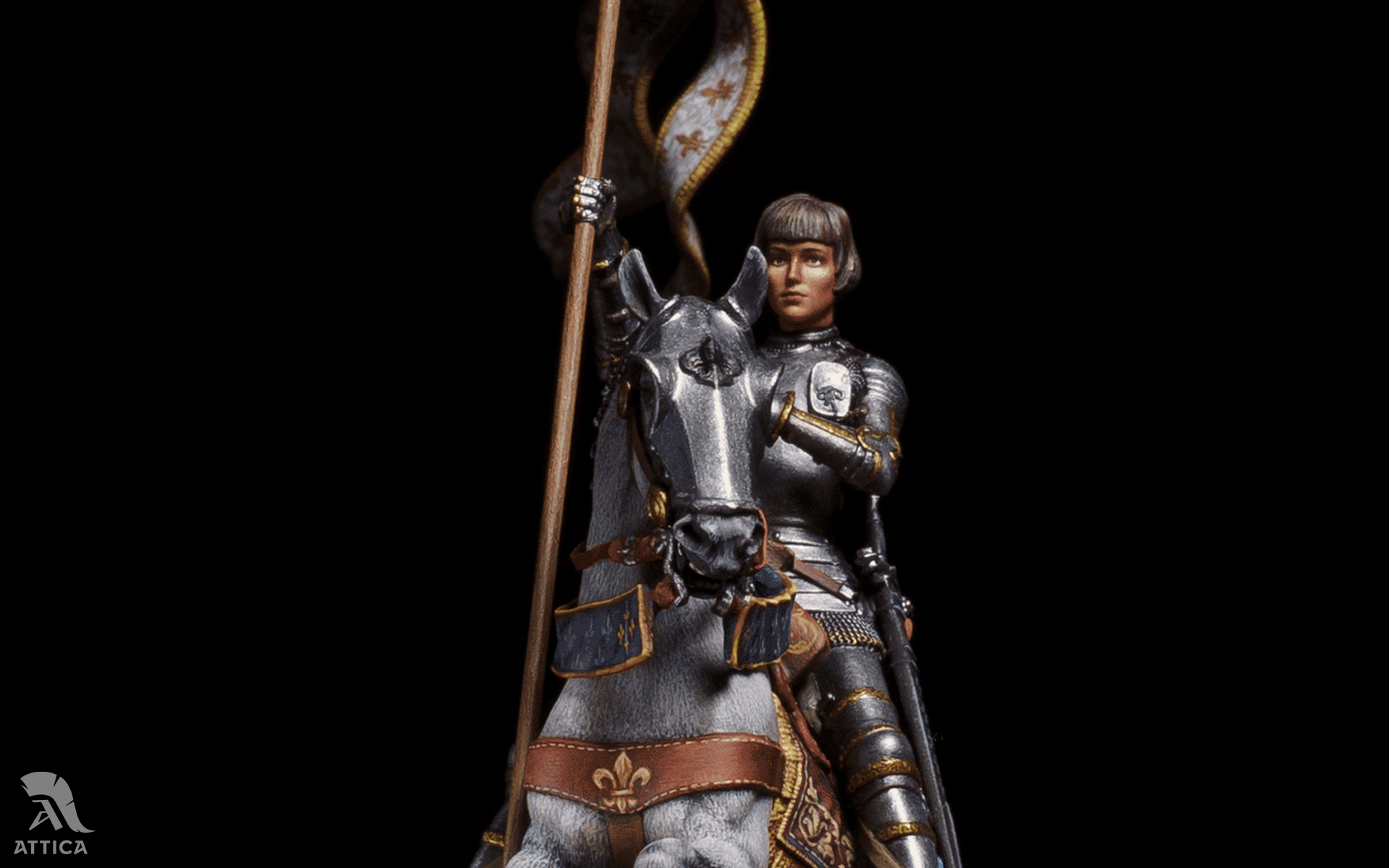 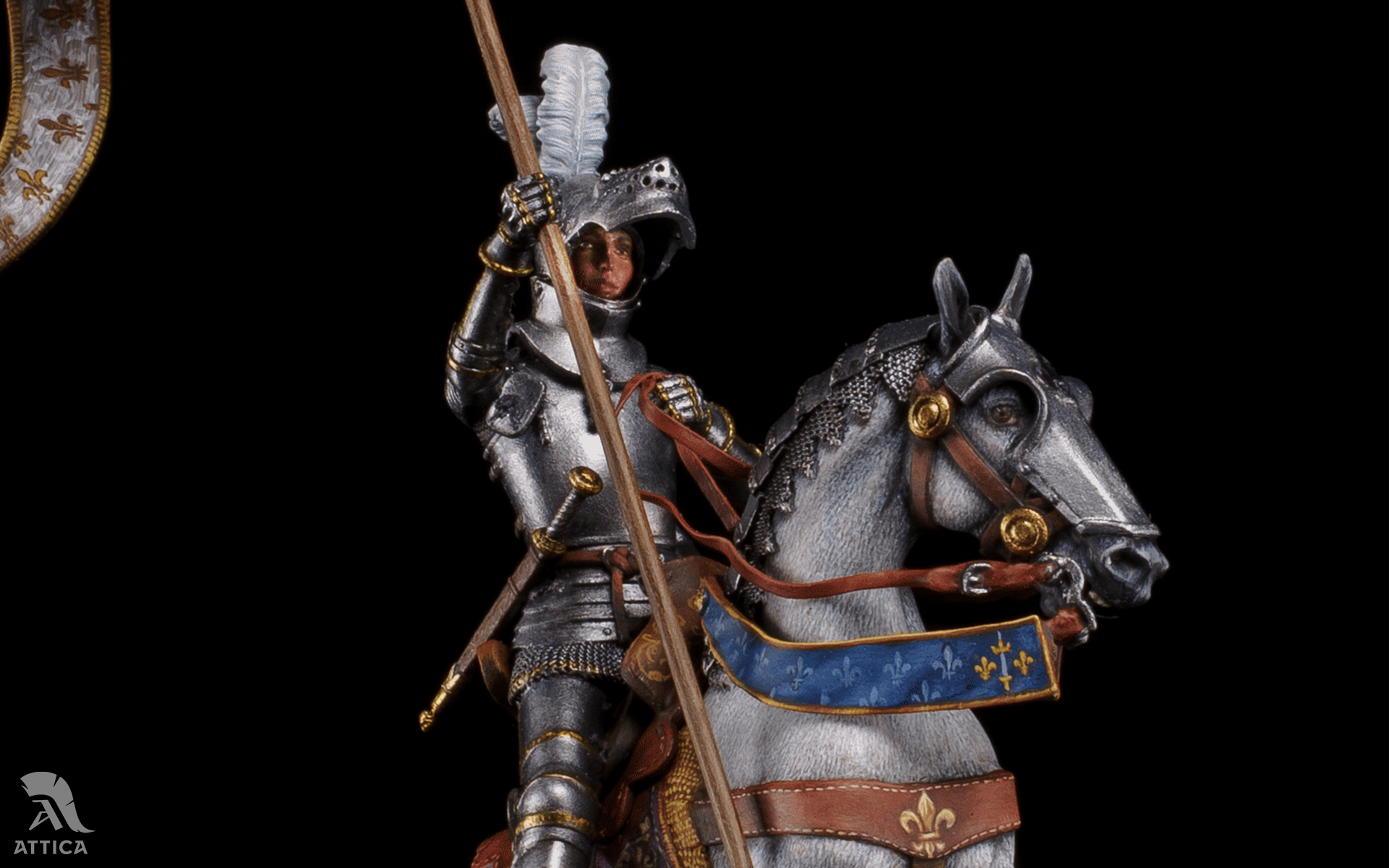 Custom historical miniatures Have an idea for a custom historical miniature?Attica Miniatures creates bespoke historical and fantasy figures for private collectors worldwide. A custom project can begin with a historical personality, a portrait, a scene, a specific period, or a single powerful idea. Our studio can develop the concept, historical research, sculpting, accessories, painting, scenic base, and final presentation—from the first idea to the finished one-of-a-kind miniature. A custom miniature can begin with a single historical idea. Prefer email? Write to info@atticaminiatures.com |
|
|
| |